
Facial Contouring Surgery
in Seoul, Korea

Facial Contouring Surgery At BRAUN

Facial contouring surgery is designed to reshape selected areas
of the facial bones to improve
facial width, projection, proportion, and overall balance.
At Braun Plastic Surgery in Seoul,
each surgical plan is tailored to the patient after evaluating their bone structure,
soft tissue,
facial symmetry, and individual goals.
Facial contouring procedures may include cheekbone reduction, square jaw reduction,
genioplasty (chin surgery), and revision facial contouring. These procedures may be
performed
individually or combined as part of an integrated surgical plan,
depending on the patient’s
facial anatomy and treatment goals.

What Is Facial Contouring Surgery?

Facial contouring surgery refers to a group of procedures designed to modify the shape and
proportion of the facial bones. Treatment may focus on the cheekbones, mandibular angles,
chin, or a combination of these areas.

Unlike treatments that affect only the skin or facial fat, facial bone contouring
changes the underlying skeletal framework.
Because bone structure, soft tissue, and facial proportions influence one another, a thorough evaluation
is important before determining which procedure or combination of procedures is appropriate.

Front and profile skull diagrams identifying the cheekbones, mandibular angle, and chin Front and profile skull diagrams identifying the cheekbones, mandibular angle, and chin

Facial Contouring Procedures at Braun

The appropriate procedure depends on the area of the facial skeleton
that is contributing to the patient’s concerns. Not every patient requires multiple procedures,
and treatment is planned according to individual facial anatomy and goals.

01 Cheekbone Reduction

Cheekbone reduction may be considered for prominent front or lateral cheekbones that contribute to
midface width. Surgical planning considers the direction of repositioning, fixation, facial symmetry,
and the condition of the surrounding soft tissue.

  1. Cheekbone reduction step 1 showing the lateral cheekbone osteotomy

    Osteotomy on the sideof the cheekbones.

  2. Cheekbone reduction step 2 showing removal of the inner frontal cheekbone

    The inner side of the frontalcheekbones is removed in atrapezoidal shape.

  3. Cheekbone reduction step 3 showing repositioning of the cheekbone

    To bring the excised edges ofthe bones into close contact,the remaining cheekbones are movedinwards, upwards, and backwards.

  4. Cheekbone reduction step 4 showing fixation with plates and screws

    Both the front and back are securelyfixed with titanium screws and plates.

02 Square Jaw Reduction

Square jaw reduction reshapes the mandibular angle and lower jaw contour.
Planning considers both the width of the lower face from the front and the shape of the jawline in profile.

  1. Square jaw reduction step 1 showing mandibular angle resection

    Resection of the square jaw to the sideof the chin without the formation ofa secondary angle.

  2. Square jaw reduction step 2 showing lateral cortical bone shaving

    Lateral cortical bone shaving isperformed on the entire jaw bone.

  3. Square jaw reduction step 3 showing masseter muscle reduction

    Square jaw muscles(masseter muscles)reduction via high frequency nerve block.

03 Genioplasty

Genioplasty modifies the shape, length, width, or projection of the chin. It may be considered for a
short, long, wide, asymmetric, or disproportionate chin, depending on the patient’s facial proportions and goals.

  1. Genioplasty step 1 showing an inverted V-shaped chin osteotomy

    Excise the chin bone throughan inverted V-shaped osteotomy.

  2. Genioplasty step 2 showing removal of the middle chin bone segment

    The removal of the middle chin bonesegment allows for precise controlover the length of the chin,based on the shape of the bone cut.

  3. Genioplasty step 3 showing repositioned chin segments secured with a plate

    The excised chin bone segments arethen gathered and secured with atitanium plate and screws.At this stage, the chin can be movedforward or backward.

  4. Genioplasty step 4 showing square jaw resection and cortical bone shaving

    Performing square jaw resectionand lateral cortical bone shaving.

04 Revision Facial Contouring

Revision facial contouring evaluates concerns following previous facial contouring surgery, including asymmetry,
insufficient correction, contour irregularities, previous fixation, and the condition of the soft tissue.

Before-and-after CT comparison following revision facial contouring

Who Is a Good Candidate for Facial Contouring?

Facial contouring may be an option for adults who are concerned about prominent cheekbones,
a wide or angular lower face, chin proportion, facial asymmetry, or the results of previous facial bone surgery.

Suitability cannot be determined from photographs alone. A consultation may
include an evaluation of facial structure, soft tissue, dental bite, medical history,
previous procedures, and the patient’s expectations.

A patient may be considered a suitable candidate when they:

  • Have a clearly identifiable structural concern
  • Seek an individualized result rather than a trend-based facial shape
  • Have realistic expectations and understand the limitations of surgery
  • Are medically suitable for surgery and anesthesia
  • Are able to follow preoperative and postoperative instructions

Facial Contouring vs Double Jaw Surgery

Facial contouring surgery and double jaw surgery may affect some of the
same facial areas,
but their primary purposes and diagnostic
requirements are different.

Facial contouring surgery and double jaw surgery may affect some of the same facial areas, but their primary purposes and diagnostic requirements are different.

Comparison Category Facial Contouring Surgery Double Jaw Surgery
Primary Focus Outer bone shape and facial contour Jaw position, bite, and skeletal relationship
Typical Areas Cheekbones, mandibular angles, chin Upper jaw, lower jaw, or both
Dental Bite Usually not intended to correct dental bite May change or correct dental bite
Diagnosis Contour, proportion, symmetry, soft tissue Dental, orthodontic, and skeletal evaluation

A wide face does not automatically mean that double jaw surgery is needed.

Concerns involving the dental bite or jaw position may require evaluation
beyond facial contouring alone.

A wide face does not automatically mean that double jaw surgery is needed. Concerns involving the dental bite or jaw position may require evaluation beyond facial contouring alone.

One Face, One Integrated Surgical Plan

Facial contouring should not be planned by treating the cheekbones,
jawline, and chin as separate areas.
Changing one part of the facial skeleton
may affect how the other areas appear.

Facial contouring should not be planned by treating the cheekbones, jawline, and chin as separate areas. Changing one part of the facial skeleton may affect how the other areas appear.

Braun develops an integrated surgical plan based on the patient’s overall
facial structure.
The objective is not to perform as many procedures as possible,

but to identify which areas require correction and which areas should
remain unchanged.

Braun develops an integrated surgical plan based on the patient’s overall facial structure. The objective is not to perform as many procedures as possible, but to identify which areas require correction and which areas should remain unchanged.

The planning process may consider:

  • Frontal and lateral facial proportions
  • Cheekbone width and projection
  • Mandibular and lower-face width
  • Chin length, width, and projection
  • Facial asymmetry and soft-tissue condition
  • Previous surgery, fixation, and bite relationship

Facial Contouring Surgeon
Dr. Kim Tae-Gyu

Dr. Kim Tae-Gyu is a plastic surgeon and Chief Surgeon at Braun Plastic Surgery in Seoul,
with a clinical and academic focus on facial contouring surgery.
He has presented and published academic work related to facial contouring,
including reduction malarplasty, cheekbone fixation, genioplasty, and V-line jaw surgery.

Dr. Kim Tae-Gyu is a plastic surgeon and Chief Surgeon at Braun Plastic Surgery in Seoul, with a clinical and academic focus on facial contouring surgery. He has presented and published academic work related to facial contouring, including reduction malarplasty, cheekbone fixation, genioplasty, and V-line jaw surgery.

Profile Information

  • Plastic Surgeon and Chief Surgeon at Braun Plastic Surgery
  • MD, Ph.D.
  • Member of the Korean Society of Plastic and Reconstructive Surgeons and other domestic and international plastic surgery societies
  • Academic research and conference presentations related to facial contouring surgery

Clinical Interests

  • Cheekbone reduction
  • Square jaw reduction
  • Genioplasty
  • Revision facial contouring

How Braun Approaches Facial Contouring

Diagnosis first—not a predetermined surgical package.

Braun’s approach begins with an individualized assessment
rather than a predetermined surgical package.
The medical team evaluates
the facial skeleton, soft tissue, facial symmetry, previous procedures,

and the patient’s priorities before recommending a treatment plan.

Braun’s approach begins with an individualized assessment rather than a predetermined surgical package. The medical team evaluates the facial skeleton, soft tissue, facial symmetry, previous procedures, and the patient’s priorities before recommending a treatment plan.

  1. Patient consultation at Braun Plastic Surgery

    Facial Assessment

    Patient concerns, facial proportionsand views, medical history,and previous surgical history

  2. CT imaging equipment for facial assessment

    Imaging & Diagnosis

    Bone structure, symmetry, bite,soft tissue, and previous fixation,with imaging such as3D CT or panoramic X-ray when indicated

  3. Doctor reviewing a treatment plan on a tablet

    Procedure Selection

    Only procedures supportedby the evaluation are recommended.

  4. Operating room and medical monitoring equipment

    Surgery & Recovery Plan

    Anesthesia, postoperative follow-up,recovery expectations,and relevant limitations

How to Choose a
Facial Contouring
Clinic in Korea
How to Choose a FacialContouring Clinic in Korea

Choosing a clinic should involve more than
comparing promotional photographs or
package prices. Facial bone surgery requires a
clear diagnosis, procedure-specific experience,
discussion of potential risks, appropriate
anesthesia planning,
and postoperative follow-up.

Choosing a clinic should involve more than comparing promotional photographs or package prices. Facial bone surgery requires a clear diagnosis, procedure-specific experience, discussion of potential risks, appropriate anesthesia planning, and postoperative follow-up.

Facial Contouring Clinic Checklist

  • Surgeon credentials and procedure-specific experience
  • Individualized diagnosis and treatment rationale
  • Evaluation of facial bone structure, symmetry, soft tissue, and bite
  • Alternatives, limitations, and potential risks
  • Anesthesia and patient monitoring
  • Postoperative care and follow-up
  • Clearly documented before-and-after cases
  • Final treatment plan after clinical examination

Patient Safety and Surgical Care

Patient safety should be considered throughout consultation, surgery, recovery,
and follow-up.
The care plan is tailored to the patient’s health,
procedure type,
anesthesia requirements, and, when applicable,
travel arrangements.

Patient safety should be considered throughout consultation, surgery, recovery, and follow-up. The care plan is tailored to the patient’s health, procedure type, anesthesia requirements, and, when applicable, travel arrangements.

  • Patient undergoing preoperative imaging at Braun Plastic Surgery

    Preoperative Examination
    and Review

    Medical history, medications, allergies,
    previous operations, and required
    preoperative examinations

  • Anesthesiologist monitoring a patient’s vital signs during surgery

    Real-Time Monitoring
    by an Anesthesiologist

    Anesthesia management and real-time
    monitoring of the patient’s vital
    signs throughout surgery

  • Surgeon examining a patient’s facial condition

    Immediate Recovery

    Postoperative observation, symptom
    management, written aftercare
    instructions, and guidance on when and
    how to contact the clinic urgently

  • Surgeon explaining facial anatomy and follow-up care to a patient

    Follow-up

    Scheduled examinations,
    recovery monitoring, and follow-up
    coordination for international patients

Planning Facial Contouring Surgery from Abroad

International patients should plan for both surgery and recovery
before traveling to Seoul.
An online consultation can help
with the initial assessment and discussion,
but the final surgical plan
should be confirmed after an in-person examination.

  1. Before traveling

    Share standardized photos, medical and surgical history,
    medications, allergies, and any available CT scans
    or relevant medical records.

  2. After arriving in Seoul

    Complete the in-person consultation and required
    examinations. Confirm the recommended procedures,
    limitations, anesthesia plan, recovery expectations,
    and follow-up schedule in Korea.

  3. Before Returning Home

    Attend required examinations, review medications and
    postoperative care instructions, confirm how to contact the
    clinic remotely, and discuss when it is appropriate to travel.

Recovery After Facial Contouring Surgery

Recovery varies depending on the procedure, extent of surgery, individual healing,
and whether multiple procedures are performed. Swelling and temporary sensory changes may be
more noticeable during the early recovery period and are monitored during follow-up.

Recovery varies depending on the procedure, extent of surgery, individual healing, and whether multiple procedures are performed. Swelling and temporary sensory changes may be more noticeable during the early recovery period and are monitored during follow-up.

  1. Early Recovery

    Observation, swelling, bruising,
    discomfort, and initial
    postoperative instructions

  2. Follow-Up Period

    Follow-up examinations,
    wound care, medication review,
    and symptom monitoring

  3. Daily Activities

    Return to daily activities
    depends on the procedure
    and the individual’s recovery.

  4. Long-Term Result

    Bone and soft tissues continue
    to heal and stabilize over time;
    the final appearance is not immediate.

Facial Contouring Before & After

Results vary according to facial anatomy, selected procedures, healing, and the postoperative period

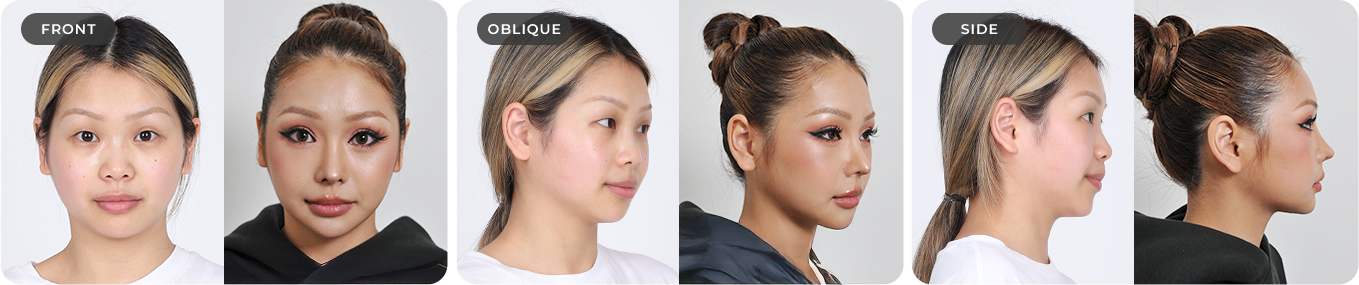
CASE 01

3-Set Facial Contouring (Cheekbone Reduction + Square Jaw Reduction + Chin Surgery(Genioplasty))

Case 01: front, oblique and side views, with before on the left and after on the right in each pair

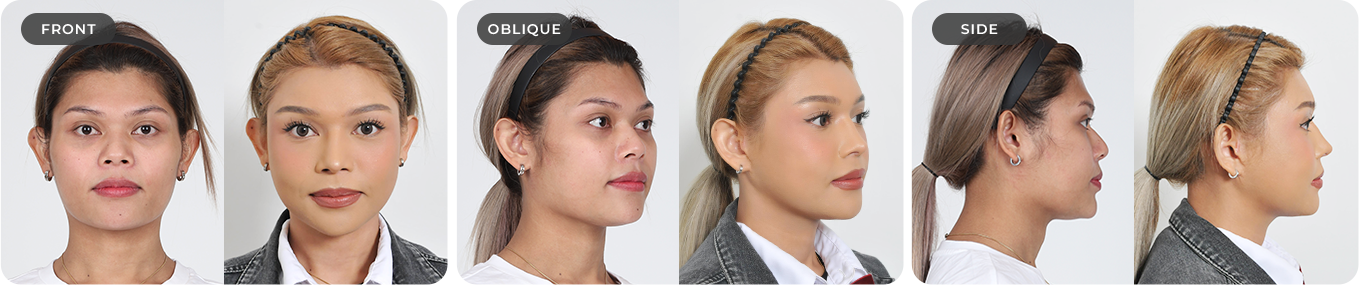
CASE 02

3-Set Facial Contouring (Cheekbone Reduction + Square Jaw Reduction + Chin Surgery(Genioplasty))

Case 02: front, oblique and side views, with before on the left and after on the right in each pair

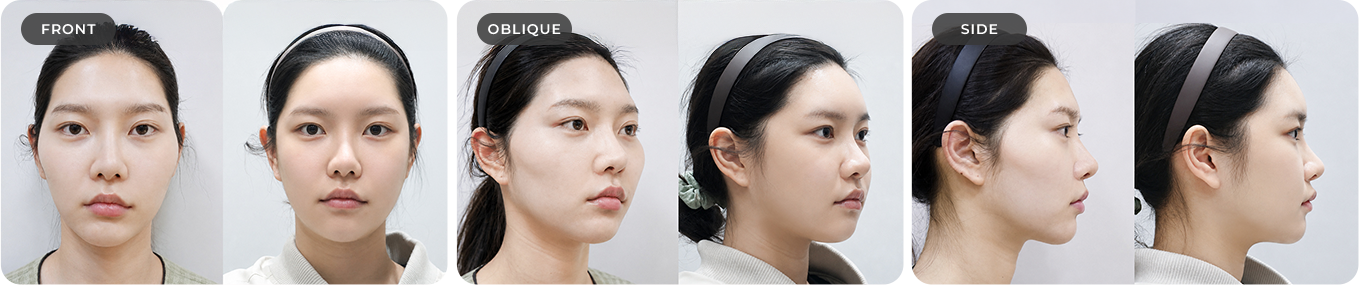
CASE 03

2-Set Facial Contouring (Cheekbone Reduction + Square Jaw Reduction)

Case 03: front, oblique and side views, with before on the left and after on the right in each pair

Frequently Asked Questions
About Facial Contouring Surgery

What procedures are included in facial contouring surgery?

Common procedures include cheekbone reduction, square jaw reduction,
genioplasty, and revision facial contouring. The appropriate procedure or
combination depends on the individual diagnosis and facial structure.

Is facial contouring the same as double jaw surgery?

No. Facial contouring primarily changes the shape and contour of selected
facial bones, while double jaw surgery focuses on jaw position, dental bite,
and skeletal relationships.

Do I need cheekbone reduction, jaw reduction,
and genioplasty together?

Not necessarily. The treatment plan should be based on the areas that require
correction. Unaffected areas do not necessarily need surgery.

How is the facial contouring surgical plan determined?

Planning may consider photographs, physical examination, imaging,
facial proportions, symmetry, soft tissue, dental bite, medical history,
and previous surgery.

Can facial contouring correct facial asymmetry?

Facial contouring may improve selected skeletal asymmetries,
but perfect symmetry cannot be guaranteed. Soft tissue and other
individual factors can also affect the final appearance.

How long is recovery after facial contouring surgery?

Recovery varies depending on the procedure, surgical extent,
and individual healing. The appropriate timing for returning to daily activities
or traveling should be confirmed during consultation.

How much does facial contouring surgery cost in Korea?

The cost of facial contouring surgery varies depending on the procedures
performed, surgical complexity, revision status, examinations, anesthesia, and
postoperative care. A personalized estimate can be provided after individual
evaluation.

Can I have an online consultation before
traveling to Korea?

An online consultation can help with the initial assessment and discussion
before traveling. However, the final diagnosis and surgical plan should be
confirmed after an in-person examination.

Plan Your Facial Contouring
Consultation in Seoul

If you are considering facial contouring surgery in Korea,
begin by sharing your concerns, photographs,
medical history, and previous surgical
information. Braun’s international consultation team can help

arrange the initial review and explain the next steps before your visit to Seoul.

If you are considering facial contouring surgery in Korea, begin by sharing your concerns, photographs, medical history, and previous surgical information. Braun’s international consultation team can help arrange the initial review and explain the next steps before your visit to Seoul.

*Complications such as bleeding, infection or inflammation may occur following the surgery, and individual satisfaction may differ: please consult with your surgeon.
닫기
BRAUN Plastic Surgery Viber QR code
BRAUN Plastic Surgery WhatsApp QR code
BRAUN Plastic Surgery WeChat QR code
로그인하셔야 본 서비스를 이용하실 수 있습니다.